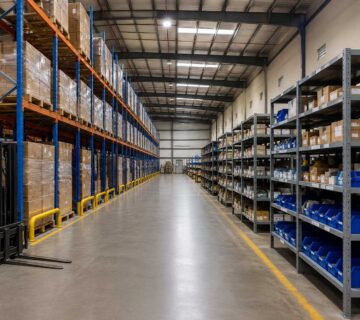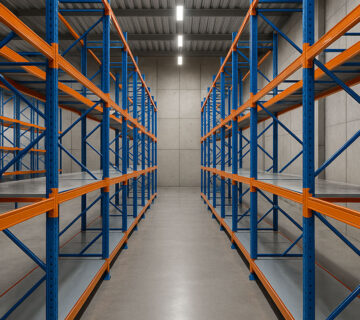
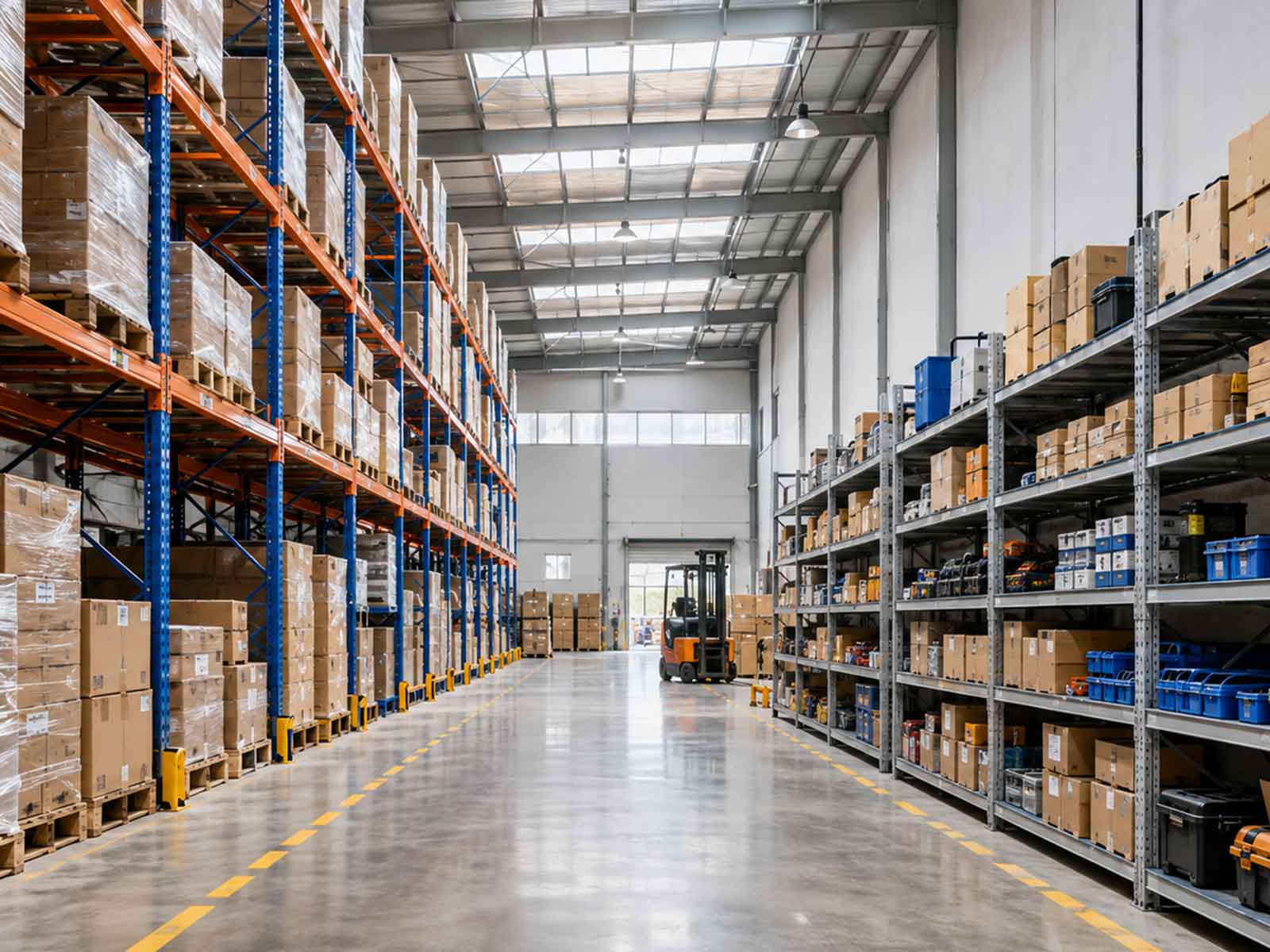
Industrial racking is designed for palletised, heavy loads with forklift access, ideal for large warehouses. Shelving is a manual, lighter-load solution suited to smaller items, spare parts, and office or retail storage. Choosing between the two in Pakistan depends on load weight, access frequency, item type, and available warehouse height.
Every square foot of your warehouse costs money. Yet most businesses in Pakistan are still losing 30–40% of usable storage capacity — not because of space constraints, but because of the wrong storage system. Whether you are managing a distribution centre in Karachi, a spare parts store in an automotive workshop, or a pharmaceutical cold chain facility, the choice between industrial racking and shelving can determine the difference between a productive operation and a constant bottleneck.
This guide by Khambatis breaks down both systems in full detail — so you can make the right call before you invest.
1. Understanding Industrial Racking Systems: What They Are and When to Use Them
Industrial racking systems are engineered steel structures designed to store palletised goods vertically, allowing forklifts or powered handling equipment to access and retrieve loads at multiple heights. The primary purpose of racking is to maximise vertical space utilisation in a warehouse environment where goods are stored in bulk quantities and moved using mechanical equipment.
In Pakistan’s growing logistics and warehousing sector — particularly in industrial zones across Karachi, Lahore, and Faisalabad — pallet racking has become the backbone of modern inventory management. It enables the FIFO (First In, First Out) and LIFO (Last In, Last Out) rotation methodologies essential for FMCG, pharmaceutical, and food storage operations.
Main Types of Industrial Racking at Khambatis
Rack Type | Best Application |
Selective Pallet Racks | High-SKU, direct access warehouses — each pallet accessible individually |
Drive-In / Drive-Thru Racks | Bulk storage of uniform product lines — maximum density, forklift entry |
Double Deep Racks | Two-pallet deep storage — balance between density and selectivity |
VNA (Very Narrow Aisle) Racks | Maximum space efficiency with specialist narrow-aisle trucks |
Cantilever Racks | Long, heavy, irregular items — steel pipes, timber, automotive parts |
When Racking is the Right Choice
- Your operation involves palletised goods on standard Euro or custom pallets
- You have or plan to invest in a forklift or reach truck
- Inventory volumes are high and items are uniform in size
- Warehouse ceiling height exceeds 4–5 metres, enabling vertical stacking
- FIFO/LIFO stock rotation is a business requirement
- You need to scale storage capacity without expanding the building footprint
2. Understanding Shelving Systems: What They Are and When to Use Them
Steel shelving systems are manually accessible storage structures designed for smaller, lighter items that do not require forklift handling. Shelving is characterised by horizontal bays that can be adjusted to varying heights, making them ideal for piece-picking operations, record storage, retail stock rooms, and workshop supply areas.
Unlike racking, shelving places items within arm’s reach of workers, making it the preferred solution for environments where individual SKUs, documents, tools, or smaller cartons need to be retrieved frequently and quickly without the use of powered equipment.
Main Types of Shelving at Khambatis
Shelving Type | Best Application |
Long Span Shelvings | Heavy cartons, automotive parts, industrial components — up to 500 kg per bay |
Slotted Angle Shelvings | Versatile, economical storage for offices, workshops, and small stores |
File Shelvings | Document archiving, file storage, government records management |
Mobile Shelvings | Space-critical environments — libraries, archives, hospitals, compact offices |
When Shelving is the Right Choice
- Items are small, light, or individually packaged (not palletised)
- No forklift access is available or needed
- The facility is an office, retail stockroom, workshop, or small store
- Frequent manual picking of individual items is required
- Ceiling height is lower (typically under 4 metres)
- You need a cost-effective, quick-install storage upgrade
3. Racking vs. Shelving: Head-to-Head Comparison
The table below provides a clear side-by-side evaluation of both systems across the most critical decision criteria for businesses operating in Pakistan’s industrial and commercial sectors.
Criteria — Racking | Criteria — Shelving |
Purpose | Purpose |
Palletised bulk storage | Individual item / piece storage |
Load Capacity | Load Capacity |
500 kg to 5,000+ kg per pallet position | 50 kg to 500 kg per shelf level |
Access Method | Access Method |
Forklift, reach truck, or order picker | Manual — hand picking by workers |
Height Utilisation | Height Utilisation |
Full ceiling height — 8m, 10m, 12m+ | Limited — typically up to 3–4m |
Installation Complexity | Installation Complexity |
Moderate to high — anchoring, column guards, beam clips | Low — bolt-together or clip-in assembly |
Cost | Cost |
Higher investment, higher ROI at scale | Lower upfront cost, ideal for smaller facilities |
Item Type | Item Type |
Bulk pallets, uniform goods, heavy inventory | Cartons, parts, files, tools, small goods |
Flexibility | Flexibility |
Adjustable beam heights, modular extensions | Fully adjustable shelf heights, easy reconfiguration |
Best Industries (Pakistan) | Best Industries (Pakistan) |
FMCG, logistics, pharma, auto, cold chain | Retail, workshops, offices, schools, hospitals |
4. The 6-Step Storage Selection Framework for Pakistani Facilities
At Khambatis, our consultants follow a structured site evaluation framework before recommending any storage system. Whether your operation is a 500 sqm spare parts store or a 50,000 sqft distribution warehouse in Karachi’s industrial corridor, these six questions will guide your decision.
Step 1 — Define Your Load Profile
Begin by identifying the heaviest and most common unit you need to store. Are goods arriving on pallets? What is the average weight per pallet or box? If loads exceed 300 kg per unit, racking is almost always necessary. Below 200 kg per level, shelving is likely sufficient. Load data also informs structural requirements and anchor specifications.
Step 2 — Assess Your Facility Height
Measure the clear usable height — from floor to the lowest obstruction (sprinkler heads, beam, or roof truss). A facility with 8+ metres of clear height benefits enormously from high-bay pallet racking. For anything under 3.5 metres, heavy-duty shelving provides a more practical and cost-effective solution.
Step 3 — Evaluate Your Access Equipment
Do you have a forklift, reach truck, or counterbalance truck on site? The presence of powered handling equipment is the single biggest factor in the racking vs. shelving decision. Racking without a forklift is inaccessible above the second beam level. Shelving without a forklift is far more practical for multi-worker environments.
Step 4 — Determine SKU Depth and Rotation Needs
How many different product lines do you carry, and how often does each move? High-SKU operations with frequent picking (100+ different items daily) generally benefit from selective racking or long span shelving for direct, row-by-row access. Bulk single-SKU operations (e.g., large FMCG distribution) may favour drive-in racks for maximum density.
Step 5 — Consider Your Budget and Timeline
Racking carries a higher upfront cost per square foot but delivers a stronger return on investment at scale through greater storage density. Shelving is faster to install and lower in initial cost — the right choice when a facility needs to be operational quickly or when budget is constrained. Both systems are manufactured locally by Khambatis in Karachi, reducing lead times across Pakistan.
Step 6 — Plan for Future Growth
Both racking and shelving from Khambatis are modular — adding bays, extending rows, or reconfiguring heights is straightforward. However, it is more cost-effective to plan the structural capacity upfront. Undersized column profiles in a racking system cannot simply be swapped out once installed. Discuss expansion plans with Khambatis at the quoting stage to ensure your system grows with your business.
5. Industry-Specific Recommendations for Pakistan
Industry / Sector | Recommended System | Khambatis Product |
FMCG & Food Distribution | Selective Pallet Racking | Selective Pallet Racks |
Pharmaceutical / Healthcare | Selective Racking + File Shelving | Pallet Racks + File Shelvings |
Automotive & Spare Parts | Long Span Shelving + Cantilever | Long Span + Cantilever Racks |
Government / Public Records | File Shelving / Mobile Shelving | File & Mobile Shelvings |
Retail / E-Commerce | Slotted Angle + Long Span | Slotted Angle Shelvings |
Manufacturing Plants | Drive-In Racks + Tool Storage | Drive-In Racks + Trolleys |
Cold Chain / Refrigerated | Selective or VNA Racking | VNA Racks / Selective Racks |
Chemical / Hazmat Storage | Double Deep or Drive-Thru | Drive-In / Drive-Thru Racks |
Each of the above system categories is available directly from Khambatis — designed, manufactured, and installed by a dedicated technical team based in Karachi. All systems comply with structural steel standards applicable in Pakistan and are engineered for local climate and operational conditions.
6. Why Khambatis Is Pakistan’s Trusted Steel Storage Partner
Khambatis combines decades of steel craftsmanship with modern engineering to deliver storage systems that are built for Pakistan’s industrial demands — not imported specifications scaled down for local use. |
Established as an evolution of a long-standing family legacy in steel and furniture craftsmanship, Khambatis designs, manufactures, and installs industrial storage systems from its Karachi facility. The company’s complete product portfolio — from selective pallet racks to mobile shelving, and from fire-rated doors to steel lockers — means customers receive integrated storage and security solutions from a single trusted partner.
What Sets Khambatis Apart
- In-house manufacturing in Karachi — shorter lead times across all major cities in Pakistan
- Technical site survey and load analysis included with every major project
- Full product range: racks, shelves, pallets, lockers, cabinets, doors, and trolleys
- Projects across warehousing, automotive, pharmaceutical, government, and retail sectors
- Post-installation support and spare component availability
- Direct contact: +92 308 0000075 | info@khambatis.com | wa.me/+923080000075
FAQ — Racking vs. Shelving in Pakistan
Q: What is the main difference between industrial racking and shelving?
A: Industrial racking is designed for heavy, palletised loads accessed via forklift and is used in large warehouses. Shelving is for lighter, manually-picked items and is better suited for offices, workshops, and smaller storage areas.
Q: Which system is more cost-effective for a small warehouse in Karachi?
A: For a small warehouse with manual picking and lighter loads, slotted angle or long span shelving from Khambatis is typically more cost-effective. Racking delivers better ROI when loads are palletised and volumes are high.
Q: Can I mix racking and shelving in the same facility?
A: Absolutely. Many warehouse facilities in Pakistan use both — pallet racking for bulk inbound storage and shelving in the picking or despatch zone for loose items. Khambatis can design a combined layout for your specific floor plan.
Q: How much weight can Khambatis’ pallet racks hold?
A: Khambatis selective pallet racks are available in a range of load configurations, typically from 500 kg up to 5,000+ kg per pallet position, depending on the beam and upright profile selected. A technical consultation will determine the right spec for your operation.
Q: How long does it take to install a racking or shelving system in Pakistan?
A: Installation timelines vary by project size. A standard shelving setup for a small facility can be completed in one to two days. A full pallet racking system for a large warehouse typically takes three to seven working days, including floor anchoring and beam configuration.
Conclusion: Make the Right Storage Investment — Get Expert Advice from Khambatis
The choice between industrial racking and shelving is not simply a matter of preference — it is a structural business decision that directly impacts your warehouse efficiency, operational cost, and long-term scalability. The wrong system wastes space, slows down picking, and creates safety risks. The right system multiplies your storage capacity without expanding your footprint.
Khambatis provides both — and everything in between. Whether you need heavy-duty pallet racking for a distribution warehouse, long span shelving for an automotive spare parts store, or mobile shelving for a hospital record room, our team will survey your site, assess your load requirements, and deliver a system engineered for your exact operation.