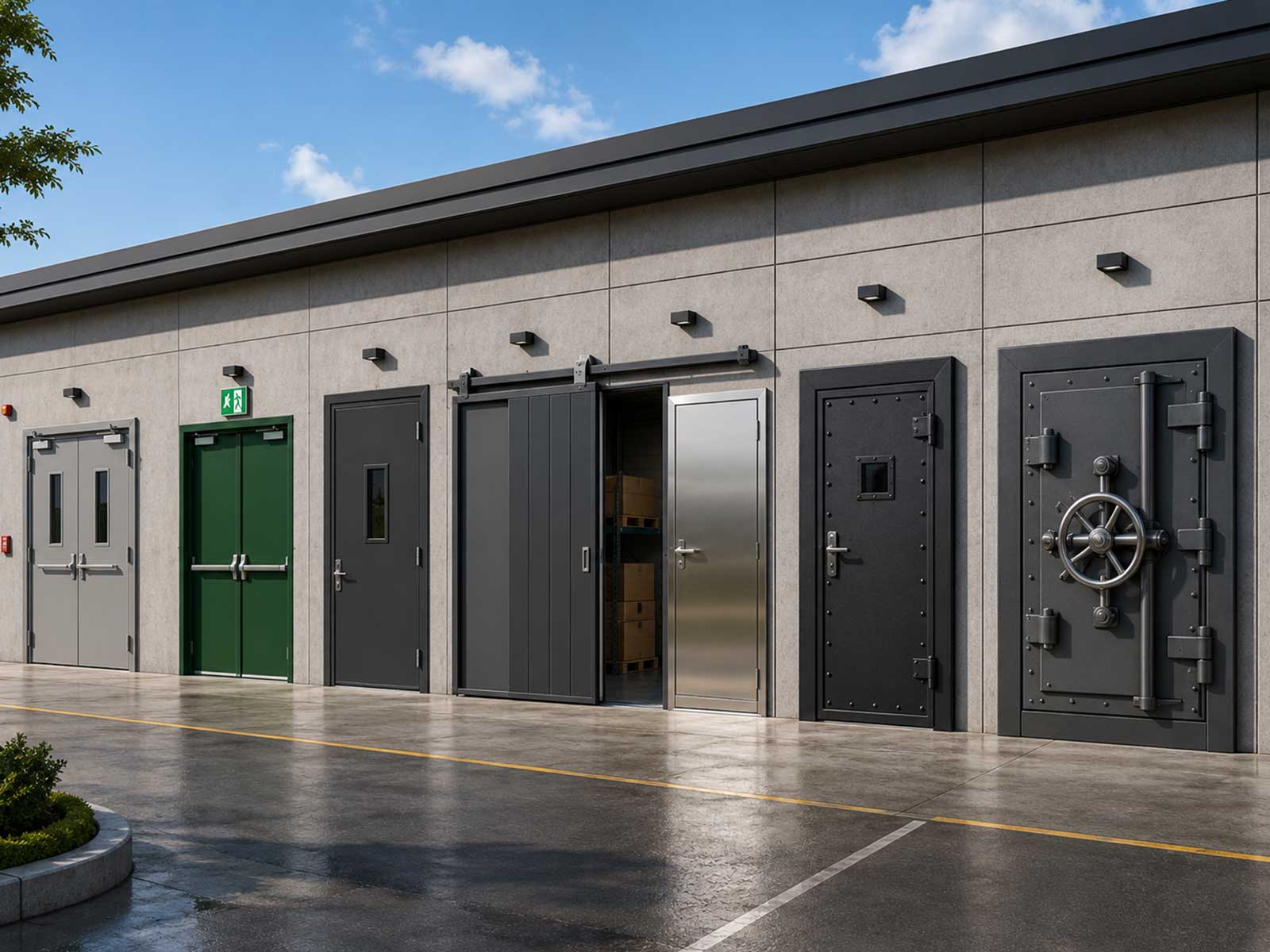
Most facility breaches don’t happen because of sophisticated hacking — they happen because someone walked through the wrong door. In Pakistan’s rapidly expanding industrial and commercial landscape, door selection and security access planning remain chronically under-engineered, often treated as an afterthought after a facility is already built.
This guide brings together everything a facility manager, project engineer, procurement officer, or business owner needs to make the right door selection decision — and pair it with the access control system that actually protects their people, assets, and operations.
1. Why Door Selection and Security Access Planning Must Go Together
A common mistake in facility planning is treating doors and access control as two separate procurement decisions — one handled by the civil contractor and the other by the IT or security team. This creates costly mismatches: electronic locks fitted to under-spec frames, mag-locks bolted to doors not designed for the load, or biometric readers wired to doors with no cable conduit provision.
The correct approach is integrated door and access planning, where the door’s hardware prep, frame spec, and locking mechanism are designed together with the access control technology from the outset. Done right, this approach:
- Reduces installation cost by eliminating retrofit work
- Improves reliability by using components designed to work together
- Creates a documented, auditable access architecture for the facility
- Supports future scalability — adding floors, zones, or credentials without structural changes
Khambatis Approach Khambatis manufactures steel doors with access control readiness built in — electric strike prep, mag-lock reinforcement plates, reader mounting positions, and cable conduit — ensuring your door is access-control-ready from day one, not an expensive retrofit project later. |
2. The Security Zone Model: Mapping Doors to Threat Levels
Before selecting any door, the first step is to map your facility into security zones. Each zone has a distinct threat profile, access frequency, and compliance requirement — and each demands a different door specification.
Zone | Description & Recommended Door Spec |
Zone 0 — Public perimeter | External facade, reception lobby. Moderate security. Single-leaf steel or aluminium composite doors, standard mortise lock, door closer. |
Zone 1 — Semi-restricted | Internal office corridors, staff areas. Card reader or keypad access. Steel door, 16-gauge min., electric strike or mag-lock prep. |
Zone 2 — Restricted | Server rooms, finance areas, HR, stock rooms. Two-factor authentication. Heavy steel door, 14-gauge, multi-point locking, access log required. |
Zone 3 — High security | Vault, armoury, data centre, chemical storage. Biometric + PIN. Vault-grade steel, reinforced frame, anti-drill cylinder, tamper alarm prep. |
Zone 4 — Emergency egress | Fire exits, stairwells, emergency routes. Fail-safe lock, panic hardware, fire-rated door. Must comply with egress code. |
Map every door in your facility to one of these zones before writing a single line of specification. If your supplier doesn’t ask about zones, ask them why.
3. Selecting the Right Door for Each Security Zone
With your zone map in hand, here is how to match door type and specification to each security level.
A. Standard Commercial Entry (Zone 0–1)
For public-facing or low-restriction zones, a single-leaf steel door with a quality mortise lock and overhead door closer is the baseline. Key specs:
- Steel gauge: 18–20 gauge (0.9mm–1.2mm)
- Frame: continuous welded steel frame, chemically anchored to masonry
- Lock: 5-lever mortise deadlock or single-cylinder deadbolt
- Closer: EN 3–5 rated overhead closer for controlled swing
- Finish: powder-coated to match facility aesthetic — also improves corrosion resistance
B. Semi-Restricted Access Doors (Zone 1–2)
These are the workhorse doors of any commercial or industrial facility — internal access points where credential control begins. Specification must accommodate electronic access integration:
- Steel gauge: 16–18 gauge minimum
- Lock prep: Electric strike cut-out in frame, or magnetic lock mounting plate on door head
- Cable conduit: 20mm conduit from door head to ceiling void for access control cabling
- Reader mounting: Pre-welded plate on door face or adjacent wall bracket provision
- Closer: Heavy-duty closer with adjustable back-check for high-traffic doors
C. Restricted and High-Security Doors (Zone 2–3)
For zones where breach has a high consequence — data rooms, treasury, chemical storage, armouries — door spec must be hardened at every element:
- Steel gauge: 14–16 gauge (1.5mm–2mm), double-skin construction for vault applications
- Frame: 3mm+ steel frame with 4-point anchor system per frame leg
- Locking: Multi-point deadbolt system (3-point minimum, 5-point for vault), anti-drill cylinder
- Hinges: 3 or more heavy-duty security hinges with non-removable pins
- Access: Biometric (fingerprint/iris) + PIN combination; standalone or networked controller
- Alarm prep: Door position sensor (DPS), tamper switch, glass-break sensor wiring provision
D. Fire Exit and Emergency Egress Doors (Zone 4)
Fire doors are a legal and insurance requirement in any facility with occupancy above a certain threshold. They are also among the most frequently misspecified doors in Pakistan’s construction sector.
- Fire rating: Minimum 30-minute (FD30) for internal partitions; 60-minute (FD60) for stairwells
- Core: Mineral wool or vermiculite board — NOT hollow or foam
- Seals: Intumescent strip on all four edges — expands under heat to seal the gap
- Hardware: Panic bar (push bar exit device) for high-occupancy exits; door closer is mandatory
- Lock: Fail-safe electric strike or magnetic lock that releases on power cut and fire alarm
- Compliance: Do not store items against fire doors; self-closing mechanism must be intact
Critical Warning A fire door propped open, or fitted with the wrong core material, provides zero fire protection. In Pakistan, fire incidents in industrial facilities have repeatedly resulted in life and asset loss where proper fire door installation was absent or bypassed. Compliance here is non-negotiable. |
4. Access Control Technologies: Choosing the Right System for Your Doors
Once your door specification is set, the next decision is access control technology. Here is a practical comparison of the main options available in Pakistan’s market.
Technology | How It Works |
Mechanical key lock | Traditional key-operated deadbolt or mortise lock. Zero electronics. No audit trail. Suitable for Zone 0 only in most facilities. |
Combination / keypad | PIN entry on a keypad. No physical credential to lose. Suitable for low-to-moderate security zones. Shared PINs reduce accountability. |
Card / fob reader | RFID or proximity card presented to reader. Individual credentials. Access log available. Industry standard for Zone 1–2. |
Mobile credential | Smartphone NFC/Bluetooth used as access credential. No physical card. Convenient for facilities with BYOD environments. |
Biometric — fingerprint | Fingerprint scan. Strong individual verification. Used for Zone 2–3. Requires enrolment process and backup credential. |
Biometric — facial recognition | Camera-based facial ID. Contactless. Increasingly used in banking, data centres, and high-traffic restricted zones. |
Multi-factor (MFA) | Two or more methods combined — e.g. card + PIN, or biometric + card. Mandatory for Zone 3 / high-security. Strongest protection. |
Intercom + remote release | Audio/video intercom at door; remote electric strike release from guard post or reception. Common in gated facilities. |
Networked vs Standalone Access Control
Standalone controllers operate independently — each door manages its own credential list and settings. Cost-effective for small facilities with few doors, but requires manual credential management at each device.
Networked systems connect all controllers to a central software platform. This enables real-time monitoring, remote access management, audit trail reporting, and credential revocation across all doors simultaneously — essential for any facility with 10+ controlled doors or multiple floors.
Integration Planning Tip If you plan to expand your facility or add doors in the future, spec a networked system from the start. Migrating a standalone system later requires replacing hardware, re-cabling, and re-enrolling all users — a significant cost. Khambatis can door-prep for both standalone and networked configurations. |
5. Electric Strikes, Magnetic Locks, and Fail Mode — What You Must Know
The locking device is the electromechanical heart of any access-controlled door. Getting this choice wrong creates either a security gap or a life-safety hazard.
Electric Strikes
An electric strike replaces the static strike plate in the door frame. When energised (or de-energised, depending on fail mode), the strike releases to allow the door to open. The door retains its standard mechanical lock hardware, making this the least visually intrusive option.
- Best for: Offices, internal doors, entry points where a conventional door appearance is preferred
- Fail-safe variant: Unlocks on power loss — required for fire exits
- Fail-secure variant: Remains locked on power loss — used for server rooms, vaults
Magnetic Locks (Maglocks)
A magnetic lock consists of an electromagnet mounted on the door frame and a steel armature plate on the door. When energised, the magnet holds the door closed with 300–600kg of holding force. Power off = door opens.
- Maglocks are inherently fail-safe — they release when power is cut
- Best for: High-traffic doors, fire exits, areas where a quick emergency release is required
- Important: Must always be paired with a request-to-exit (REX) sensor or push-to-exit button inside the secured area to prevent entrapment
Comparison | Electric Strike |
Fail mode options | Fail-safe or fail-secure |
Visual profile | Low — blends with door frame |
Holding force | Moderate (300–600 lbf) |
Best use | Offices, internal doors |
Power requirement | Low (100–300mA) |
REX required? | No (but recommended) |
6. Designing Your Facility’s Access Hierarchy
An access hierarchy defines who can enter which zones, at what times, and under what conditions. Without a documented hierarchy, facilities end up with either everyone having access to everything — or chaotic ad-hoc permissions that no one can manage or audit.
A Simple 5-Level Access Framework
Level | Who |
Level 1 — Visitor | External visitors, delivery personnel |
Level 2 — General staff | All full-time employees |
Level 3 — Departmental | Staff assigned to specific departments |
Level 4 — Management | Senior staff, managers |
Level 5 — Security / Facilities | IT admin, facilities team, security |
Each level should be programmed into the access control system and reviewed quarterly. Terminated employees, contractors, and visitors must be removed from the system immediately upon exit — this is where many facilities have gaps.
7. Common Mistakes in Door Security Planning — and How to Avoid Them
- Specifying the door after the wall is built: Non-standard opening sizes create expensive custom work. Always plan door openings at structural drawing stage.
- Ignoring cable provision: Running access control cable after installation means surface-mounted conduit — unsightly and easier to tamper with. Plan conduit at the door manufacturing stage.
- Choosing the wrong fail mode: A fail-secure lock on a fire exit is a life-safety violation. Every door’s fail mode must match its zone and occupancy requirements.
- Shared PIN codes: When multiple people use the same PIN, you lose the audit trail entirely. Individual credentials are non-negotiable for Zone 2 and above.
- No door position sensors: Without a DPS, your access control system doesn’t know if a door was held open, propped, or forced. DPS is the minimum monitoring standard.
- Overlooking the REX device: Every magnetically locked door needs a request-to-exit sensor on the secured side. Absence of REX creates an entrapment risk.
- Buying the lock before the door: Access control hardware must be specified alongside — not after — the door. Frame cut-outs, reinforcement plates, and conduit all depend on lock type.
Conclusion: Security Starts at the Door
Your facility’s security posture is only as strong as its weakest access point. By combining the right door specification with a properly planned access control system — from zone mapping to credential hierarchy to fail-mode selection — you build a facility that is not just physically secure, but operationally auditable and scalable for years to come.
Khambatis Private Limited specialises in the manufacture and installation of industrial and commercial steel doors across Pakistan. Our doors are engineered with access control readiness built in — because securing your facility shouldn’t be an afterthought.