Choosing the wrong door for your facility is an expensive mistake — and in Pakistan’s growing industrial sector, it’s more common than it should be. Whether you’re outfitting a new warehouse in Karachi, retrofitting a factory in Lahore, or securing a commercial building anywhere in the country, the door you install is one of the most critical decisions you’ll make for security, compliance, operational flow, and long-term ROI.
This guide covers everything buyers, facility managers, procurement officers, and project contractors need to know before purchasing industrial or commercial doors in Pakistan — from types and materials to security features, compliance requirements, and questions every supplier should answer before you sign a purchase order.
1. Industrial vs Commercial Doors: Understanding the Difference
Before buying, you need to understand the core distinction — because confusing the two leads to under-spec’d doors in high-stress environments, or over-engineered (and over-priced) doors where a simpler solution would do.
| Feature | Industrial Door vs Commercial Door |
| Primary environment | Industrial: factories, warehouses, logistics hubs | Commercial: offices, retail, business premises |
| Usage frequency | Industrial: very high (100–500+ cycles/day) | Commercial: moderate (20–100 cycles/day) |
| Material gauge | Industrial: 1.2mm–2mm+ steel | Commercial: 0.8mm–1.5mm steel |
| Security priority | Industrial: maximum — reinforced frames, multi-point locking | Commercial: moderate to high |
| Aesthetics priority | Industrial: low | Commercial: moderate to high |
| Typical formats | Industrial: single/double leaf, rolling shutter, sectional | Commercial: single leaf, frameless glass, aluminium composite |
| Fire rating need | Often required near storage, processing, utility zones | Required for exit routes, stairwells |
Key takeaway: If your environment involves forklifts, heavy equipment, hazardous storage, or round-the-clock operations — you need industrial-grade doors. Do not let a supplier upsell commercial-grade as ‘heavy-duty.’
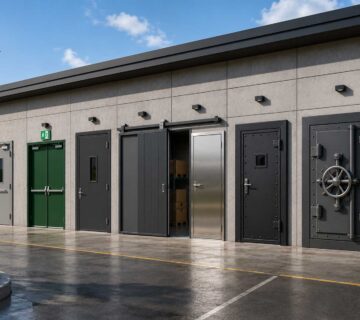
2. Types of Industrial and Commercial Doors — Which One Do You Need?
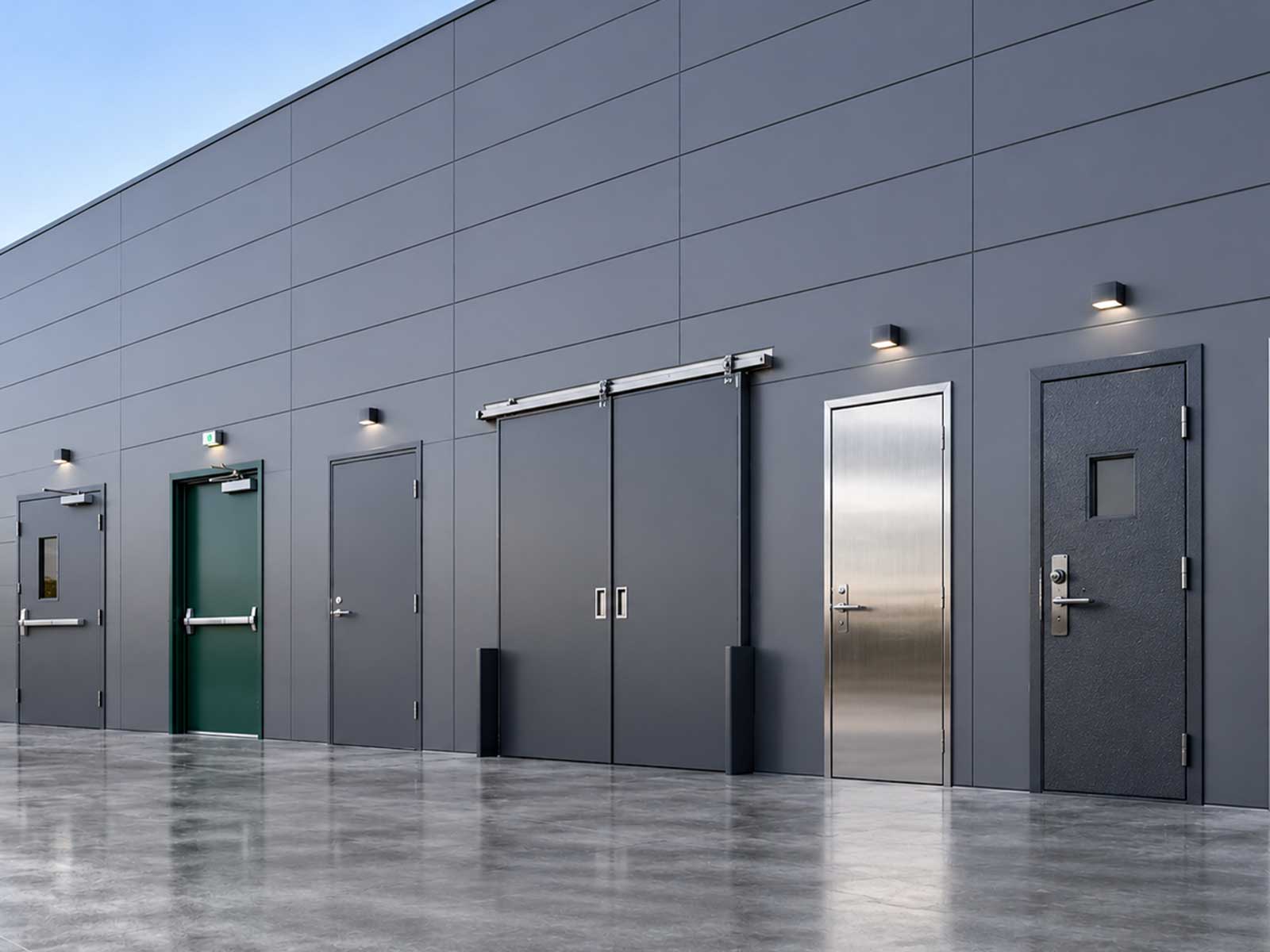
Pakistan’s industrial and commercial construction landscape uses a range of door types. Here’s a breakdown of the most common options and where each one belongs.
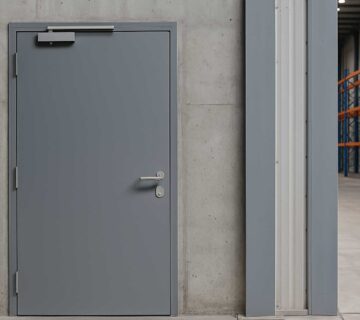
A. Single-Leaf Steel Doors
The most versatile and widely used category. A single door slab mounted on a steel frame with hinges. Suitable for personnel access points, utility rooms, storerooms, and secondary exits. Can be manufactured in a range of sizes with flush or embossed surfaces.
- Best for: Office back entrances, server rooms, storage rooms, utility access
- Khambatis advantage: Custom-manufactured in Karachi with powder-coat finish, multi-point locking options, and frames designed for masonry or steel structures
B. Double-Leaf Steel Doors
Two door panels meeting at a centre astragal, allowing wide clearance for equipment movement while maintaining full door integrity when both leaves are closed. Ideal for loading bays, dispatch areas, and main factory entrances.
- Best for: Warehouses, factories, dispatch areas requiring pallet/equipment access
- Key spec to verify: Astragal seal, flush bolt engagement, and locking rod clearance
C. Fire-Rated Steel Doors
Specially constructed with fire-resistant core materials, intumescent seals, and certified hardware to contain fire spread for 30, 60, or 120 minutes. Required by building codes in exit stairwells, electrical rooms, and near flammable storage.
- Compliance note: In Pakistan, PSQCA standards and insurance requirements typically mandate fire doors in industrial facilities above a certain square footage
- What to check: UL listing or equivalent, intumescent strip presence, door closer compliance
D. Rolling Shutter Doors
Motorised or manual curtain-style doors that roll up vertically. Highly space-efficient and well-suited for vehicle bays, loading docks, and external perimeter openings where horizontal swing clearance isn’t available.
- Best for: Warehouses with vehicle access, petrol stations, cold storage bays, parking structures
- Maintenance note: Rolling shutters require periodic lubrication, motor servicing, and slat inspection
E. Sectional Overhead Doors
Panels that open upward along a horizontal track mounted to the ceiling. Common in high-clearance vehicle bays and logistics facilities where vertical headroom is available. Offer better thermal sealing than rolling shutters.
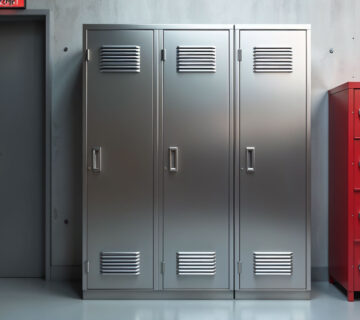
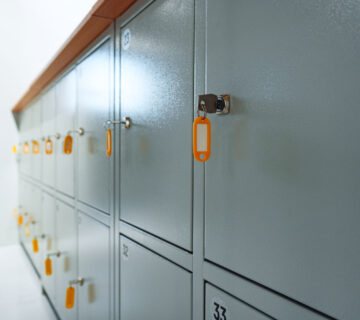
F. Security Cabinets and Locker Room Doors
Not technically ‘doors’ in the structural sense, but critical access-control elements in manufacturing plants, banks, armories, and high-value storage. Often require multi-point or electromechanical locking.
Pro Buyer Tip from Khambatis Pakistan’s coastal humidity (especially in Karachi) accelerates corrosion on standard cold-rolled steel. Always specify galvanized steel or powder-coated finishes with edge-sealing for any door installed in port areas, near waterways, or in open-sided industrial sheds. |
3. Key Materials and Construction Specifications
Not all steel doors are made equal. Here are the specifications that determine whether a door is worth its price — and questions to ask any supplier.
| Specification | What to Look For |
| Steel gauge/thickness | 18–20 gauge (0.9mm–1.2mm) for commercial; 14–16 gauge (1.5mm–2mm) for industrial |
| Frame material | Rolled steel frame, min. 1.5mm; should be continuous weld, not spot-welded |
| Core fill | Hollow (light-duty), polyurethane foam (insulated), or mineral wool (fire-rated) |
| Hinge specification | Continuous piano hinge or 3 heavy-duty ball-bearing hinges min. for heavy doors |
| Lock type | Multi-point deadbolt for security doors; mortise lock for standard commercial |
| Surface finish | Epoxy primer + polyurethane topcoat (powder coat) preferred; standard paint insufficient in humid climates |
| Frame anchoring | Chemical anchor bolts into RCC or masonry — ensure proper embedment depth is specified |
| Threshold seal | Rubber or brush threshold sweep to prevent water ingress and vermin entry |
4. Security Features to Evaluate Before Buying
In Pakistan’s industrial sector, physical security remains a top priority — both against external breach and internal pilferage. Here’s what to evaluate:
Multi-Point Locking Systems
A door with only a single-point mortise lock is a weak link in any security chain. Industrial and high-security commercial doors should feature 3-point or 5-point locking — engaging bolts at the top, bottom, and centre — making forced entry significantly harder.
Anti-Drill and Anti-Pick Lock Cylinders
Lock cylinder quality matters. Standard cylinders can be picked or drilled in under a minute by an experienced intruder. Specify EN1303 or equivalent rated cylinders for high-security environments.
Reinforced Lock Box and Hinge Protection
The area around the lock box and hinges is where most forced entry occurs. Reinforced steel lock boxes and concealed or protected hinges significantly improve door resistance.
Access Control Integration
For facilities requiring controlled entry, door prep for electronic access (card readers, biometric, magnetic locks) should be specified upfront — retrofitting is expensive and often aesthetically poor. Discuss electric strike or electromagnetic lock mounting at the design stage.
Door Viewer and Communication Panels
For gatehouse or reception doors, door viewers, intercom prep, or CCTV mounting brackets may be needed. These should be specified as part of the door package, not added ad hoc.
5. How to Choose the Right Door for Your Facility — A Step-by-Step Framework
Use this decision framework when shortlisting doors for any industrial or commercial project in Pakistan:
- Define usage frequency: How many open/close cycles per day? High-frequency environments need heavy-duty hinges and locking mechanisms rated for 200,000+ cycles.
- Identify the access type: Personnel only, forklift or pallet jack access, vehicle bay, or fire exit? This determines door width, height, and format (swing, shutter, sectional).
- Assess security threat level: Is the door on an external perimeter, internal partition, or high-security zone? Match the security spec to the actual threat.
- Check compliance requirements: Does your facility require fire-rated doors under PSQCA, insurance, or tenant requirements? Fire doors must be installed with certified frames and closers.
- Account for environmental conditions: Coastal/humid environments require galvanized or powder-coated finishes. Cold storage requires thermally broken frames.
- Verify customisation options: Non-standard openings are common in older industrial buildings. Confirm the supplier can manufacture to exact dimension.
- Request a site visit and measurement: No reputable industrial door supplier should quote without site measurement — opening dimensions, wall thickness, and structural condition all affect spec.
- Ask for references: Request project references from similar industries. Khambatis, for example, has 300+ completed projects and 7,000+ doors installed across Pakistan.
6. Common Buyer Mistakes to Avoid
- Choosing by price alone: cheap doors fail faster and compromise security. Total cost of ownership (TCO) matters.
- Not specifying the frame: a quality door in a weak frame is as insecure as no door. Frame spec is as important as the door slab.
- Ignoring installation quality: even the best door fails if improperly anchored. Always include installation in your procurement scope.
- Buying residential doors for industrial use: residential-grade steel doors are not engineered for high-frequency industrial use.
- Forgetting compliance: fire exits and fire-rated zones are non-negotiable for insurance coverage and regulatory compliance.
- Skipping after-sales support: confirm warranty terms and availability of spare parts (cylinders, closers, hinges) before purchase.
7. Questions to Ask Every Industrial Door Supplier
Before placing any purchase order, ask your prospective supplier these questions:
- What steel gauge are you using, and can you provide a material certificate?
- Is the door manufactured locally or imported? If local, where?
- What is the door’s tested cycle rating for hinges and locking?
- Can you provide a fire rating certificate for fire-rated products?
- Do you offer site measurement and installation services?
- What is your warranty period and what does it cover?
- Can you manufacture non-standard sizes?
- Do you have reference projects in our industry segment in Pakistan?
Conclusion: Buy Smart, Buy Once
Buying an industrial or commercial door in Pakistan isn’t just a procurement decision — it’s an investment in your facility’s security, compliance, and operational continuity. Armed with the right specifications, the right questions, and a supplier who understands your industry, you can avoid costly mistakes and choose doors that serve your facility for decades.