
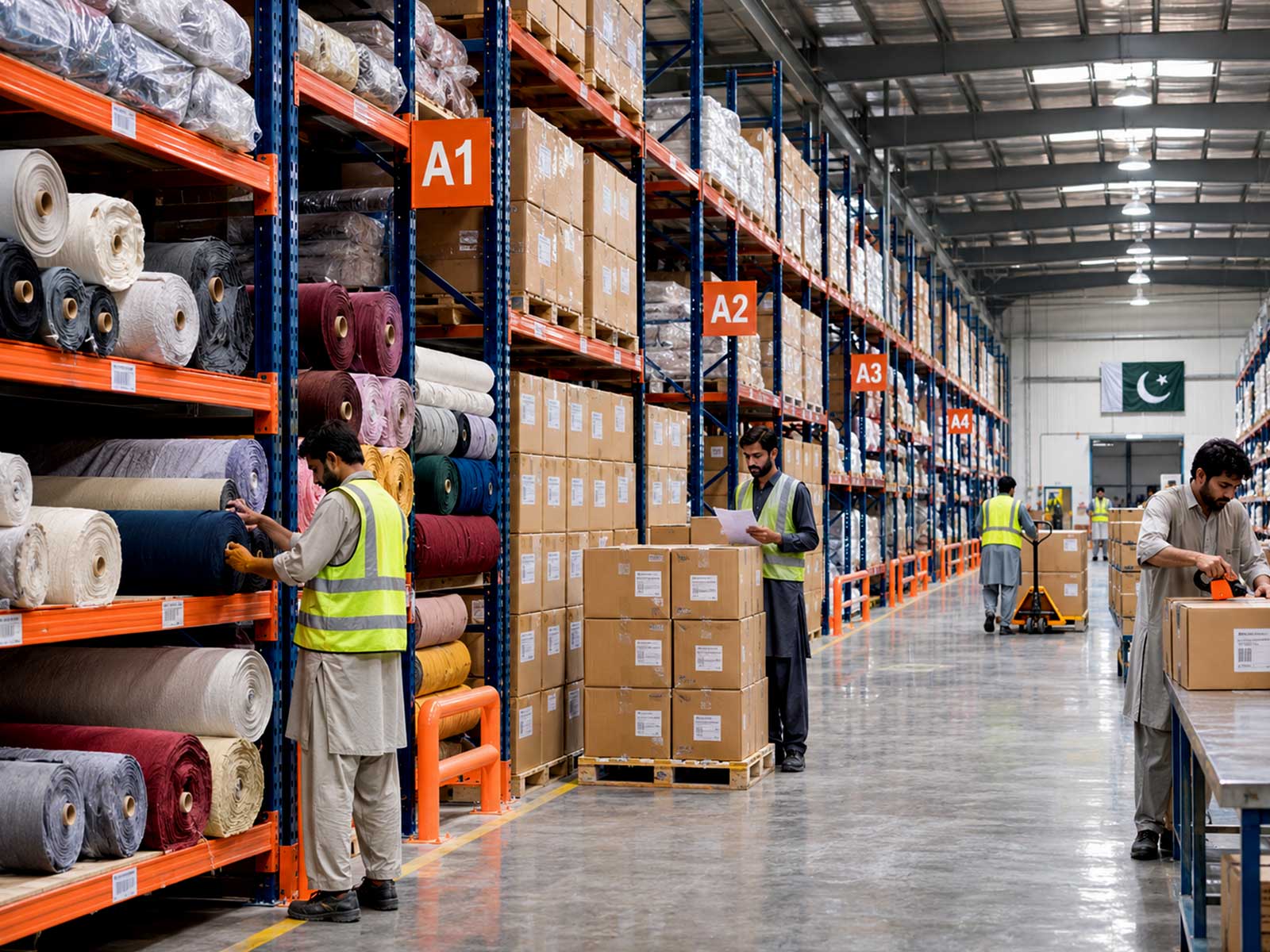
Quick Answer Pakistan’s textile and garment export sector, the country’s largest export industry needs racking designed around bulky, irregularly shaped inventory: rolled fabric, folded bales, and cartoned finished garments, often with sharp seasonal demand swings. Long span shelving suits cartoned and folded goods, while cantilever racking handles long fabric rolls that don’t fit conventional pallet racking. Storage design also needs to support buyer compliance audits, common in export-oriented apparel manufacturing. |
Why Textile Warehousing Is a Different Storage Problem
Textiles and garments remain Pakistan’s largest export sector, anchored by major hubs in Faisalabad, Karachi, and Lahore. But textile inventory doesn’t behave like typical palletized goods — rolled fabric bolts, folded bales, dyed yarn cones, and cartoned finished garments each have different shapes, weights, and handling requirements that standard pallet racking often handles poorly.
Storage Solutions Matched to Textile Inventory Types
- Rolled fabric and long fabric bolts: cantilever racking, which supports long items on open arms without the obstruction of vertical frame posts, is far better suited than boxed pallet racking
- Folded fabric bales and cartoned garments: long span shelving offers wide, adjustable shelf levels ideal for bulky, irregularly sized cartons that don’t fit standard pallet dimensions
- Yarn cones and smaller components: boltless or slotted angle shelving with bin systems for organized, SKU-level storage
- Finished, export-ready cartons: palletized selective racking for staging and container-loading efficiency
Designing for Pakistan’s Textile Seasonality
Textile and garment production for export runs on buyer order cycles and seasonal collections, creating sharp peaks in finished-goods inventory ahead of shipment windows. Warehouse storage design needs flexible capacity — often through a mix of fixed racking for base inventory and reconfigurable shelving zones that can absorb seasonal overflow without permanent expansion.
Storage Design and Buyer Compliance Audits
Export-oriented Pakistani textile manufacturers frequently undergo warehouse audits from international buyers as part of sourcing compliance — covering fire safety, organized storage, clear aisle access, and traceable batch identification. Racking and shelving layout plays a direct role here: cluttered, poorly labelled, or aisle-blocking storage is a common audit finding that a properly designed racking system prevents by default.
Fire Safety Considerations Specific to Textile Storage
- Adequate aisle clearance for fire safety access, not just forklift movement
- Storage height limits relative to sprinkler system coverage, where fitted
- Segregated storage zones for raw fabric versus finished, packaged goods where fire load differs
- Clear signage and unobstructed emergency exit routes through racking layouts
Faisalabad, Karachi, and Lahore: Regional Considerations
Textile warehousing needs vary somewhat by hub — Faisalabad’s dense mill and weaving cluster often means space-constrained facilities needing high-density shelving solutions, while Karachi’s export-processing and port-adjacent warehouses prioritize fast turnaround staging for container loading. Racking design should reflect these operational realities rather than applying a single generic layout across regions.
Getting Textile Warehouse Storage Right
Because textile inventory shapes vary so widely — from a fabric roll to a folded garment carton — a single racking type rarely covers a full textile warehouse efficiently. Khambatis works with Pakistani textile and garment exporters to design mixed storage layouts combining cantilever, long span shelving, and palletized racking matched to each inventory type and compliance requirement.
Frequently Asked Questions
What racking is best for storing fabric rolls?
Cantilever racking is generally best for long fabric rolls and bolts, since its open-arm design supports long items without the frame obstructions of conventional pallet racking.
How should a textile export warehouse be organized?
Textile warehouses typically benefit from a mixed storage approach — cantilever racking for fabric rolls, long span shelving for cartoned goods, and palletized racking for export-ready staging.
What is cantilever racking used for in textile storage?
Cantilever racking supports long, bulky items like fabric rolls and bolts on open horizontal arms, allowing easy loading and retrieval without vertical frame obstructions.
Does Pakistan’s textile export sector need compliance-specific storage?
Yes, export-oriented textile manufacturers often undergo buyer compliance audits covering fire safety, organized storage, and clear aisle access, all of which are directly affected by racking and shelving design.
Which cities need textile warehouse racking most in Pakistan?
Faisalabad, Karachi, and Lahore are Pakistan’s primary textile and garment manufacturing and export hubs, each with warehousing needs shaped by local space and logistics conditions.